Orientalism in French Nineteenth-Century Art: The Enigma of The East
By Alexandra A. Jopp
Orientalism in French Nineteenth-Century Art:
The Enigma of The East
Table
of Contents
Introduction
Methodology of the Study
A Note on
Terminology
Origins
Orientalism Deconstructed
Romanticism
and Orientalism in France
Eastern Exotica Through Western Eyes
Artists
Conclusion
Selected Paintings
Works Cited
 |
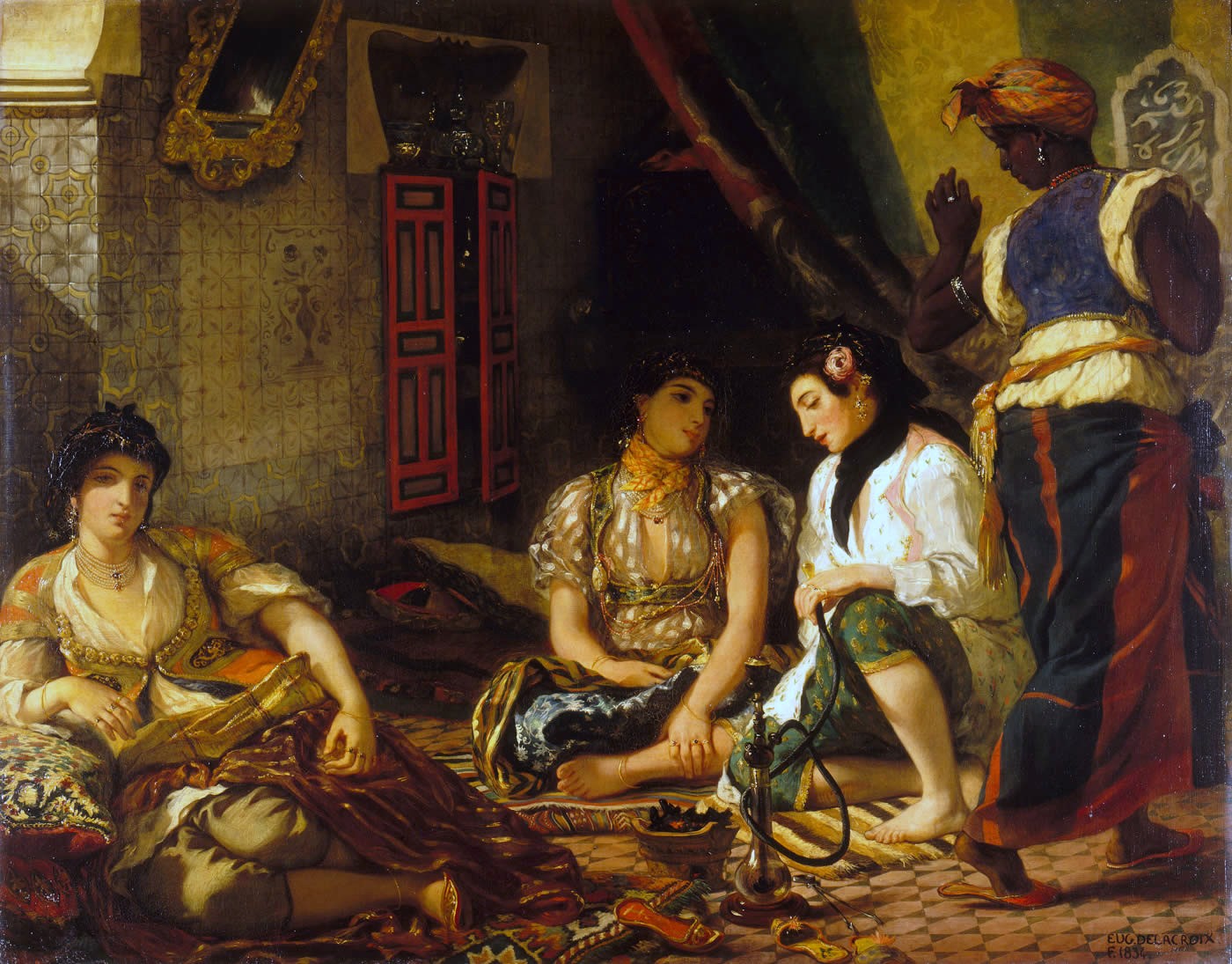
| Eugène Delacroix. The Women of Algiers (in Their Apartment). 1834. Oil on canvas. 180 × 229cm. Louvre. |
The stream of love, the stream of sadness!
And I have asked thy marble’s white:
I’ve read the praise to lands of aliens,
But Mary was not there implied.
The pale star of the harem, dreary!
Are you forgotten in a past?
Or whether Zarema and Mary
Are only happy dreams for us?
Alexander Pushkin, To
the Fountain Of the Palace Of the Bakchisarai
Introduction
Orientalism, Victor Hugo observed, had a major impact on French and
English culture in the nineteenth century. “There is more interest in the East
nowadays than there has ever been. Never before have Eastern studies made such
progress. In the age of Louis XIV, everyone was a Hellenist, now they are all
Orientalists. Never have so many fine minds, at one and the same time, delved
into the abyss that is Asia. … Everywhere the East has come to preoccupy the
mind and imagination. … Everything there is large, rich, and fertile,” Hugo
wrote in Les Orientales (Jullian 47).
The primary focus of this paper will be to consider the development of
nineteenth-century Orientalism on French art history, with a systematic look at
several of the “fine minds ... [who] delved into the abyss that is Asia.” The
Romantic period is comparable to the great epochs of the past in the number of
outstanding artists that it produced, such as Eugene Delacroix, Jean-Leon
Gerome, Jean Auguste Dominique Ingres and others. The historical changes that
occurred in Europe at the end of the eighteenth century and continued through
the nineteenth century – starting with the French Revolution in 1789,
Napoleon’s invasion of Egypt and French colonization of the Maghreb – set the
tone for Orientalist art. This paper will provide a historical overview of the
movement, along with examples and analyses of paintings that were influenced by
Europeans’ increased exposure to Eastern cultures.
The geopolitical situation, diplomatic and artistic relations and a
growing interest in Eastern studies all played a significant role in the
Orientalist movement, as did the myriad and ambiguous cultural attitudes that
spread out around Europe throughout the nineteenth century. Of particular
importance were European attitudes regarding Eastern exotica. In discussing the
changes that took place, this paper will focus on (a) the historical impact of
the Orient on nineteenth-century French art, an
effect that both was caused by and was a contributor to the phenomenon of
Orientalism, and (b) the fascination that Europeans developed regarding the
most exotic features of the Orient, particularly as seen in the imaginative
depictions of harems by Western artists. These phenomena combined to produce
masterful works of art that, inasmuch as they were not always faithful
representations of life in the East, have become, to some critics, symbols of
Euro-centrism and a Western tendency to define other peoples, often in a
sensationalized way. This paper will examine both the artistic achievement and
the cultural controversy of Orientalist art.
Methodology
of the Study
The primary research
methodology used in this project is a literature review, with a focus on
selected paintings. Due to the broad impact of Orientalism, it is impossible to
include all of the artists who worked in the genre. Therefore, this paper will
examine most closely three French artists (Delacroix, Gerome and Ingres) who,
in my opinion, were the most influential in using Oriental features to modify
traditional Western and Romantic art. In addition, my personal experience as a
native of the Crimea (Crimea was a part of the Ottoman Empire from the
fourteenth through the seventeenth centuries, and the Crimean War of 1854-55
brought the Near East into the southern part of the Ukraine and influenced its
language, ethnicity and culture) and as a visitor to France, Turkey, Iran and Tajikistan inform
my perspective for this study.
A Note on Terminology
Explaining the term “Orientalism” could be a thesis in itself, as it is
rich with varying interpretations that often reflect the user’s own cultural
attitudes. I use the term frequently throughout the paper, however, so a
working definition is necessary. Even the more straightforward word “Orient”
can lead to confusion, as Westerners, especially Americans, tend to think of
the Orient as exclusively Asian. Much of the Oriental influence addressed in
this paper, though, came from the Arab world. For the purposes of this paper, I
have leaned most heavily on Edward Said’s definition of Orientalism, as
developed in his landmark book of the same name: it is a term used “to describe
the Western approach to the Orient; Orientalism is the discipline by which the
Orient was (and is) approached systematically, as a topic of learning,
discovery, and practice” (Said 73). Orientalist influences grew out of Eastern
cultures, but, as will frequently be noted below, they were shaped by Western
attitudes.
Origins
Before the geographical discoveries of the fifteenth century, the
Western understanding of the East was based largely on myth. As travel and trade outside of Europe increased,
though, the East grew as a center of cultural activity, and the Western image
of the region became somewhat more grounded in reality (though certain myths
and stereotypes certainly persisted.). The East, while becoming somewhat more
known to Europe in the sixteenth, seventeenth and eighteenth centuries,
nonetheless remained an exotic place, and fascination with the region grew (at
least for those few people in early modern Europe who had the means to indulge
in such fascination).
Orientalist influences began to peak around the turn of the nineteenth
century. In 1798, interest in the Orient increased
sharply when Baron Dominique Vivant Denon, who had
accompanied Napoleon Bonaparte during the French invasion of Egypt, brought
back to Europe many ruins of the pharaohs, along with samples of Egyptian
dress. In addition, the Napoleonic campaigns would lead to the battle
pictures of Antione-Jean Gros (i.e., Napoleon
Visiting the Pesthouse at Jaffa, 1804)
and Anne-Louis Girodet-Trioson (i.e., The Revolt of Cairo, 1810). The war for independence in Greece
in the 1820s contributed to the Orientalist movement as well, as many
Europeans, including the English writer Lord Byron, joined the fight on behalf
of the birthplace of Western civilization and, in the process, were exposed to
the Eastern world as represented by the Ottoman Empire. Byron’s writings during the war were
enthusiastically received all over Europe and helped to rally the West to support
Greece. In the poem “The Isles of Greece,” he wrote:
Must we but weep o’er days more blest?
Must we but blush? Our fathers bled.
Earth! render back from out thy breast
A remnant of our Spartan dead!
Of the three hundred grant but three,
To make a new Thermopylae.
Must we but blush? Our fathers bled.
Earth! render back from out thy breast
A remnant of our Spartan dead!
Of the three hundred grant but three,
To make a new Thermopylae.
While Byron invoked the historic stand of 300 Spartans against hundreds
of thousands of Persian invaders at the Hot Gates in 480 B.C., Eugene Delacroix
roused European emotions with his dramatic rendering in 1824 of Turkish
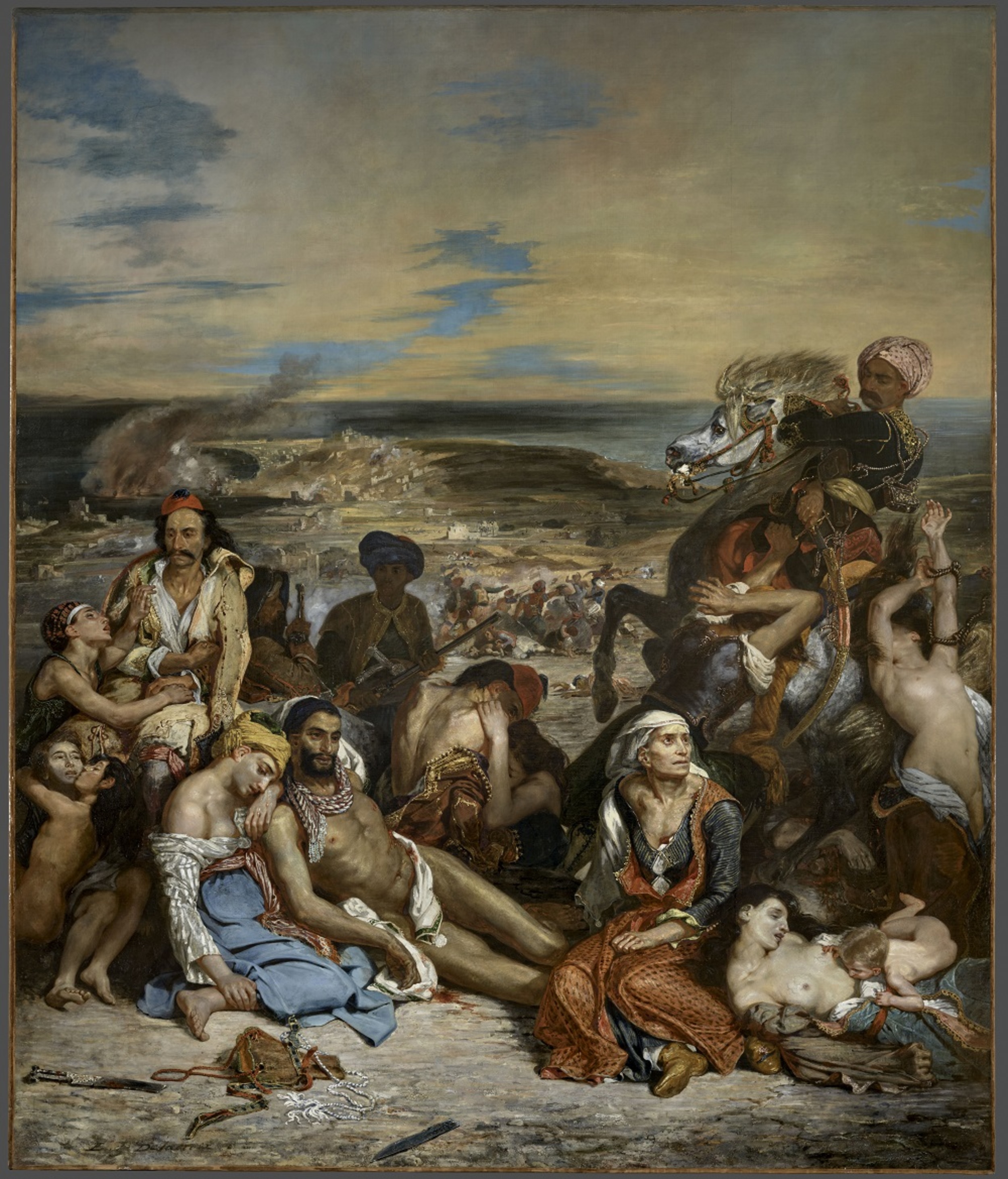
atrocities during the contemporary Greek war against an Eastern power in Massacre at Chios. Clearly, these were
not flattering accounts of the Orient. Nonetheless, they were a part of the
increasing European exposure to the East.
Byron had also written about the East before the war, in the poem “Childe
Harold’s Pilgrimage,” which described his Oriental travels. Novels and Byron’s
poems were filling artists’ minds with new and exciting visions. The paintings
of this period were created mostly based on fantasy; the artists gained a sense
of colors through the use of imported images – such as prints from overseas and
Persian miniatures – and the stories of travelers. Some of the best painters,
such as Ingres, never traveled to the Near or Far East and others, such as
Delacroix, made only brief visits, sometimes after the completion of many
Orientalist works. This approach to Orientalist art – basing it on imagined
images of the East – would soon change, though, and, in Gerald Needham’s words,
“That fabulous East – with the voluptuous nudes of Ingres, the implied
lesbianism in the sketches by Monsieur Auguste, and the violence of Delacroix –
was superseded in the 1830s” (339). By the mid-1830s, Western artists were
spending more and more time outside of Europe and Orientalist art, as a result,
became more representative of reality. The popularity of traveling to the East
for inspiration reached such heights that Charles Gleyre, a nineteenth-century
Swiss academic painter, said of artists in
Cairo, “I find at least a dozen painters here, all bursting with talent by
their own account” (339).
In his 1978 book Orientalism, Edward Said wrote of the East – or
“the Orient” – as being regarded as “a locale requiring Western attention,
reconstruction, even redemption. The Orient existed as a place isolated from
the mainstream of European progress in the sciences, art, and commerce. Thus
whatever good or bad values were imputed to the Orient appeared to be functions
of some highly specialized Western interest in the Orient” (206). By the nineteenth century, however, the
European understanding of the East had matured to the point that, while certain
mysteries and misunderstandings remained, at least some myths had given way to
reality. Eastern ideas regarding religion and philosophy began to be integrated
into European culture, a shift that went a long way toward destroying the
West’s mythological image of the East. These influences were frequently not
embraced in the West, however, and it was not until the middle of the twentieth
century that such Eastern ideas were widely, though by no means universally,
respected in Europe.
The penetration of Eastern culture into the West that began in the
nineteenth century and grew in the twentieth changed things so dramatically, however,
that some Europeans, in contrast to the idea of the East requiring “Western
attention, reconstruction, even redemption,” could actually speak of “Orientalising”
the West. By the Romantic period of the latter half of the eighteenth century,
a fashion for the Orient had developed, particularly in France, where a taste
for Chinese vases, screens, fans and small garden houses – symbols of luxury,
of a different world thought to be full of mystery and eroticism – had already
developed during the Baroque period in the court of Louis XIV. But even with a
greater understanding of Eastern culture, and even with a much more welcoming
attitude toward that culture, Europeans’ approach to the East and its ways were
unavoidably colored by their own attitudes regarding such things as traditional
societies, spirituality and the mystical understanding of exotica. Said wrote
that the Orient is “an idea that has a history and a tradition of thought,
imagery, and vocabulary that have given it reality and presence in and for the
West,” while Orientalism was (and, in some cases, still is) “a system of
knowledge about the Orient, an accepted grid for filtering through the Orient
into Western consciousness.” (5) Because of this construct, some stereotypes
and mysteries would always remain.
Orientalism Deconstructed
Orientalism has a broad meaning that spans philosophical,
architectural, literary and artistic disciplines. It intertwines not just with
European history but also with the history, religion and traditions of the
Orient itself. The term Orientalism is, first of all, associated with works of
the nineteenth century French Romantics. In Orientalism, Edward Said
gave the first critique of the subject. Said offered three definitions of
Orientalism. The first is purely academic: anyone who studies, lectures on or
writes about the East could be called an Orientalist, and his or her occupation
could be called Orientalism, although Said noted that the term is not often
used in this sense in the scholarly world. The second meaning offered by Said
relates to the “ontological and epistemological” differences between East and
West and the use of those distinctions as a starting point for academic,
political, social and artistic examinations of the East. Thus, the term is
based on a Western mentality that emphasizes the stereotypes of “Western” and “Eastern”
cultures. It is Said’s third definition of Orientalism that is his most
memorable, however. Orientalism, he wrote, is a “corporate institute for
dealing with the Orient” in a manner that assumes Western superiority and,
through its condescending approach, reinforces Euro-centric prejudices.
Orientalism, he wrote, is related to an “enormously systematic discipline by
which European culture was able to manage – and even produce – the Orient
politically, sociologically, militarily, ideologically, scientifically, and
imaginatively” (Said 3). Orientalists in the hegemonic West, in other words,
assumed for themselves the power to define the East as a way of dominating it.
“The Orient,” Said wrote, “was almost a European invention, and had been since
antiquity a place of romance, exotic beings, haunting memories and landscapes,
remarkable experiences” (1). Rana Kabbani continues Said’s idea, stating,
“in the European narration of the Orient, there was a deliberate stress on those
qualities that made the East different from the West, exiled it into an
irretrievable state of ’otherness” (5-6).
Among the many themes that emerge from the European narration of the
“other,” two appear most strikingly. The first is the insistent claim that the
East was “a place of lascivious sensuality,” and the second that it was “a
realm characterized by inherent violence” (Heizer 45). Depictions of exotica are a recurrent theme
in Orientalist art. While traveling from Spain through North Africa to Turkey
and India, artists painted their experiences in the Near and Middle East. Even
artists who never visited the region – Jean Auguste Dominique Ingres, for example
– joined in, painting scenes that existed only in their imaginations, as shaped
by the accounts of others.
Any discussion of Orientalism must begin with subject matter, for that,
rather than style, is where Eastern influences are most prominently seen. As
interested as European artists were in painting the Orient’s people, places and
objects, they seem to have had no interest in Islamic art. (This contrasts with
the Western interest in Japanese art. In this case, it was the nation’s unique
artistic style, more than its cultural aspects, that captivated Westerners.)
This literal objectification of the features of another culture has been the
source of many criticisms of Orientalism. An exhibition on “Orientalism: The
Near East in French Painting, 1800-1880” at the Memorial Art Gallery,
University of Rochester, in 1982 raised questions related to the cultural
attitudes and biases that have never been completely separated from
Orientalism. Most significantly, as we think about such paintings as Delacroix’
Sardanapalus and Gerome’s Slave Market, “will it embarrass us by
representing a world distinguished primarily either by cruel punishments and
dripping blood or by a distasteful sensuality as lustful Arabs probe naked,
white slave girls?” (Needham 338.) While the majority of Orientalist paintings do
render the Middle East without the sensationalism of “complaisant sex and
casual violence” – with recreations of scenes of bazaars and hunts, for example
– it is notable that these generally are not the best known Orientalist images.
Romanticism
and Orientalism in France
While the Orient had been a subject of interest to European artists,
writers, and politicians during the Age of Enlightenment – in France, the Siècle
des Lumières – “this interest became particularly widespread
during the Romantic movement against the backdrop of the industrial revolution
and the advancement of modern imperialism” (Colmeiro 1). As Raymond Williams, one of Britain’s
greatest post-war cultural historians and theorists, noted, “Romanticism
rejected industrialism and encouraged an interest and admiration for idealized
pre-industrial societies and a desire to return to a pre-modern past” (36). Escapism, in many forms, from idyllic Roman
landscape scenes to the popularity of Greek dress and furnishings, was an
ongoing part of nineteenth-century thinking. In European art, this contributed
to the production of works depicting exotic lands and Oriental culture. The new
Romantic concept of beauty included exotica – something unique, uncommon,
unexplored, sensual and erotic. This cult of the exotic explains the
fascination of French and British painters with the Near and Far East, Northern
Africa and the Mediterranean region, particularly as reflected in the
picturesque Orientalist paintings of Eugene Delacroix, Jean-Leon Gerome and
Jean Auguste Dominique Ingres. For these painters and others in the Romantic
era, Orientalism would become an essential feature of their work. Images from
the Near and Far East, with landscapes and peoples so different from the ones
known to most artists, had the effect of “liberating them from the chains of
classical traditions”(Paolucci 48).
“One of
the preoccupations which profoundly affected the Western understanding of the
Near East was the belief that this region could satisfy the West’s urge for exotic
experience,” Mary Anne Stevens wrote. “Exoticism meant the artistic exploration
of territories and ages in which the free flights of the imagination were
possible because they lay outside the restrictive operation of classical rules”
(17). Thus, the Oriental movement in Romantic art made it possible for the
artists “to move freely either in actual reality or on the wings of
imagination.” Alfred Musset, a leading figure of the Romantic movement in
France, listed Eastern influences as among the most basic and inspiring of the
Romantic era:
Romanticism is the star that weeps, the wind
that wails, the night that shivers, the flower that flies, and the bird that
exudes perfume. Romanticism is the unhoped-for ray of light, the languorous
rapture, the oasis beneath the palm-tree, ruby hope with its thousand loves,
the angel and the pearl, the willow in its white garb. Oh, sir, what a
beautiful thing! It is the infinite and the star, heat, fragmentary, the sober
(yet at the same time complete and full); the diametrical, the pyramidal, the
Oriental, the living nude, the embraceable, the kissable, the whirlwind (Hugo 73).
Thus, artists and poets equated the East with distinctive Romantic
features: beauty, sensuality and an alluring world full of passion. Moved by
the power of the beauty of the East, they created some of their best works
based on this new (to them) exotic world. While many artists occasionally used
Oriental themes, others such as Delacroix went
much further in bringing the East – at least, their vision of it – to Europe.
Delacroix’s Massacre at Chios, for
example, is said to have an “exotic orientalism and savage cruelty [that]
clearly exhibit its connection with the contemporary romantic movement” (Friedlaender 112).
As the nineteenth century advanced, Oriental influences could be
increasingly found in both French and non-Gallic literature (the writings of
Montesquieu, Voltaire and Goethe, for example) and art (i.e., the paintings of
Delacroix, Ingres, Etienne Dinet, Eugene Fromentin, Horace Vernet, and
Alexander Decamps). While Orientalist influences spread throughout Europe, “no
other country,” according to Philippe Jullian, “gave so much space to it in its
exhibitions as France” (47). The French military also played a key role in
bringing, as Jullian put it, “the Near East and the Middle East increasingly
into the mainstream of European affairs.” (28) The colonization of the Near
East that began with Napoleon’s 1798 invasion of Egypt both resulted from and
advanced Orientalism as defined by Said. A presumption of superiority allowed
Europeans to believe that they could rightfully control the people of these
lands, and the increased exposure to the Near East that followed the military
conquests led to fascination, if not always full respect, for these “exotic”
lands among academics and artists. The most significant Near Eastern influences
began in North Africa. This area, particularly Algiers, the capital of Algeria,
would become a crossroads of Arabic, African and European cultures. More and
more vessels from Provencal, Genoa and Catalonia would come into the port of
Algiers to take out honey, oil, fruit and olives, and almost all of the major
French impressionists worked here, including Henri Matisse, Claude Monet,
August Renoir and Edgar Degas. “There are two cities in the world: Paris and
Algeria,” nineteenth-century French writer Jull de Goncourt said. “Paris is a
city for everything; Algeria is a city for artists.”
Eastern Exotica Through Western Eyes
The East has been very tempting to Western observers for centuries. It
has always been an eternal enigma, an eternal “other,” unknown, exclusive and
hidden from the eyes of Europeans under the black, silky veil of tokens and
legends. It has typically been seen as a hot, restless, extremely emotional,
vigorous, sometimes aggressive but invariably seductive and attractive world.
Everything draws to it: its exteriors and interiors, its softness and
aggressiveness, its love and hate.
Like so many painters, some writers were drawn to the enigma of the
East by the allure of unfamiliar perspectives. Lord Byron, while traveling
through Western Anatolia (the place was very accessible to Europeans since, as
early as sixteenth century, England maintained diplomatic relations with the
Ottoman Empire) would write passages on how the East had captured his
imagination. (As noted above, Byron’s attitude toward the rapidly aging man of
Europe would become much more belligerent during Greece’s war for
independence.) Not every writer was as impressed with the Ottoman portion of
the Orient, though. Flaubert was disappointed in Turkey, since, “Istanbul was not
the East he was looking for” and
“the baked Orient of the Bedouin and the desert, the vermillion depths of
Africa, the crocodile, the camel, the giraffe” better suited his perception of
what the East should look like. (Pamuk 287) It was Egypt that captured Flaubert’s
imagination. Leaving Cairo, he wrote in a letter to his mother that the Orient
“extends far beyond the narrow idea I had of it. ... Facts have taken the place
of suppositions – so excellently so that it is often as though I were suddenly
coming upon old forgotten dreams” (McDonald 60).
For many Western travelers, “facts” did not always replace
“suppositions,” though. To Europeans, the Middle East often was less a real
place than a creation of one’s own, an enigma, a fantasy, a reflection of one’s
own attitudes. To depend upon tradition alone is hard, so one must rely on
inhabitants to present a real picture of the East. If this is not possible, the
European tries to define the East with Western eyes and mind, a challenging
task even to the most well-meaning and culturally sensitive. Vincent von Gogh
wrote that, in order to understand the East, one must look at it with the
Eastern eyes and understand how the natives live and feel. To be able to look at the world with the eyes of
another, to have more than a one-sided view of the world, to try to make the
unknown conceivable was not always achieved, even by the finest writers and
artists.
In Istanbul: Memories and the
City, Orhan Pamuk quotes Walter Benjamin’s examination of Franz Hessel’s Berlin
Walks: “If we were to divide all the existing descriptions of cities into
two groups according to the birthplace of the authors, we would certainly find
that those written by natives of the cities concerned are greatly in the
minority” (Pamuk 240). What is commonplace to a native – what would
hardly inspire them to put pen to paper – is often alluring and exotic to a
visitor. It is, in other words, literally something to write home about. When
one travels to a new city, simple things such as cobblestone streets, miniature
shops, exotic fountains, unique architecture or bustling markets can be
fascinating. When the traveler goes back to his native land, he looks at the
visited city through the eyes of memory. His description has features of a
self-portrait refracted by nostalgia, an effect that is especially pronounced
if the visited city lives among the ruins of a lost empire. So, with cinematic
fluidity, Orientalism moves from a glamorous, bloody and vibrant history to the
gorgeous, authentic lands of enigma overlooking the Mediterranean and deserts,
from the dawning of its self-actualization to the wild imagination of the
Western artists, poets and writers who would shape European consciousness of
the Middle East, North Africa and Turkey. Eugene Delacroix’s painting Women of Algiers in Their Apartment,
Jean Auguste Dominique Ingres’s Grande
Odalisque, and Jean-Leon Gerome’s depictions of nude bathers are a few
examples that will be examined further, beautifully painted and eternally
moving works of art that combine imagination with reality in depicting the
Orient.
Most intriguing to European artists were often the East’s women. Almost
always, there is a softness in the way they are depicted, but it is combined
with a strength that is exhibited as they revel in the feel of their own
glamour and essence. “Step back from the canvas, think, feel,” as Renoir would
say (Nochlin 3). One must love a female body in order to paint such scenes: “there is love
for women in each detail of the canvas, and love for self, and there is joy,
and there is a degree of sensual integration that makes you want to weep, so
beautiful it seems, and so elusive,” continues Renoir (Nochlin 4). Pliant and alluring, Gerome’s women, in particular,
are sublime on his canvas. Bathers embody a whole tradition of male power and
feminine demonstration which underpins so much of the exoticism of the Orient.
Female images in Orientalist art are often presented in the context of
the harem. As Ruth Bernard Yeazell writes in Harems of the Mind, though,
“any study of the West’s relations with the harem must be in large part a study
of the imagination” (Yeazell 1). Indeed, early Western harem images were
produced without the benefit of the artists ever having seen an actual harem.
This led to the harem being viewed in the West as “a sexualized space in which
the husband [sultan] has sexual access to limitless women in condition of
absolute despotic power” (Lewis 401). There is also a difference in the male
and female views of the harem. If a woman sees the seraglio as a family place
or a center of social gathering, the male’s view is just the opposite, and we
can see this in European paintings in which male artists, in depicting nude
women, would “playfully imagine themselves as participants in exotic adventures”
(Dietrich 32). Richard Francis Burton, in Personal Narrative of a Pilgrimage
to El-Madinah and Meccah, offered an approving, though less titillating,
view of the harem: “Europe now knows that the Moslem husband provides separate
apartments and a distinct establishment for each of his wives, unless, one be
an old woman and the other a child. And, confessing that envy, hatred, and
malice often flourish in polygamy, the Moslem asks is monogamy open to no objections?
As far as my limited observations go, polyandry is the only state of society in
which jealousy and quarrels about the sex are the exception and not the rule of
life” (Burton 326). Contrary to widespread perception in the West, however, critics
insist that the harem was not the East’s precursor to the Playboy Mansion. As
Reina Lewis noted in her review of Yeazell’s Harems of the Mind, “that
the harem was in no way structurally linked to multiple sexual attachments, was
resolutely ignored by Western writers and artists as they promulgated a vision
of the harem as sexual prison affording the sultan unrestrained sexual activity”
(Lewis 402).
The great French Romantic writer Alexandre Dumas was as influenced by
the Orient as any painter. In one passage of The Count of Monte Cristo,
for example, he describes a room as having been “fitted up in strict accordance
with Oriental ideas; the floors were covered with the richest carpets Turkey
could produce; the walls hung with brocaded silk of the most magnificent designs
and texture; while around each chamber luxurious divans were placed, with piles
of soft and yielding cushions, that needed only to be arranged at the pleasure
or convenience of such as sought repose.” (668) But, as with so many of Europe’s painters, it
was in feminine beauty where Dumas found the greatest exoticism and mystery of
the East:
The young girl herself generally passed her
time in the chamber at the farther end of her apartments. This was a sort of
boudoir, circular, and lighted only from the roof, which consisted of rose-colored
glass. Haidee was reclining upon soft downy cushions, covered with blue satin
spotted with silver; her head, supported by one of her exquisitely moulded
arms, rested on the divan immediately behind her, while the other was employed
in adjusting to her lips the coral tube of a rich narghile, through whose
flexible pipe she drew the smoke fragrant by its passage through perfumed
water. Her attitude, though perfectly natural for an Eastern woman would, in a
European, have been deemed too full of coquettish straining after effect (669).
In this passage, Dumas references another of the most iconic of the
East’s exotica: the narghile, or hookah. The English writer, Lewis Carroll used
this image, as well, writing in Alice’s Adventures in Wonderland about
the Caterpillar smoking a hookah in such a way that it is apparent that Carroll
himself had smoked a hookah or, at least, observed others doing so: “The Caterpillar
and Alice looked at each other for some time in silence: at last the
Caterpillar took the hookah out of its mouth, and addressed her in a languid,
sleepy voice … Who are YOU? … In a minute or two the Caterpillar took the
hookah out of its mouth and yawned once or twice, and shook itself” (Carroll 46).
Just as European writers enjoyed bringing the exotic ritual of smoking
a hookah into their books, many Western artists were eager depict it in their
paintings, most notably in Women of
Algiers in Their Apartment (Eugene Delacroix, 1834), Odalisque and Slave (Jean-Auguste Dominique Ingres, 1839), Bashi-Bazouk Chieftain (Jean-Leon
Gerome, 1881), Allumeuse de Narghilé
(Jean-Léon Gérome) and Harem Pool
(Jean-Leon Gerome).
As with the harem, the hookah is an example not only of European
fascination with the Orient, but also of the Western tendency to redefine
aspects of Eastern cultures in an over-exoticized manner. While to Europeans,
the hookah came to represent glamour and upper-class living – smoking a hookah
became a symbol of luxury and aristocracy in France – to women and men of the
Near and Far East, smoking a hookah was neither exotic nor high-brow, but,
rather, a symbol of family living, companionship, clarity and harmony.
In the seventeenth and eighteenth centuries, a vogue for many things
Chinese came to Europe. This new direction in decoration came to be known as
chinoiserie, the dictionary definition of which is “a recurring theme in
European artistic
styles since the seventeenth century, which reflects Chinese art
and is characterized by the use of fanciful imagery of an imaginary China, by asymmetry
in format and whimsical contrasts of scale, and by the attempts to imitate Chinese
porcelain and the use of lacquer like materials and decoration.” At
the end of the eighteenth and beginning of the nineteenth centuries, country
palaces, interiors and park pavilions took on a fashionable Chinese style. The
interior of the Château de Chantilly, a historic chateau located in the town of
Chantilly, France, for example, was painted with chinoiserie compositions, as
was the Trianon de Porcelaine, which had been built for Louis XIV
at Versailles.
In the eighteenth century, the taste for Chinese spread from the French
court all across Europe, from Palermo up to St. Petersburg. Even in
conservative England, people decorated their interiors in the Chinese style.
Dawn Jacobson, in Chinoiserie, writes that “the fantasy and romantic
appeal of the Far East in general, and China – or Cathay as it was poetically
known – in particular were the chief inspirations for the style that would be
dubbed chinoiserie” (7). Jacobson adds that the chinoiserie style was
one of the strongest and steadiest trends in European aesthetics, as the
fantastic world of China ignited the imagination of Europeans with visions of
an exotic place far from their homes. In the nineteenth century, though, the
fashion of chinoiserie would give way to Turkish and other equally exotic
Eastern styles.
Turkish influence on European art grew significantly in the late
eighteenth century. Yirmisekiz Mehmed Çelebi, Turkish first ambassador to Paris
in 1720, planted the seed for turquerie – a fashion that involved reproduction
of Turkish art and décor. French society accepted Turkish exotica in the form
of clothes, pipes and aromas enthusiastically. The French upper class embraced
Turkish baths and massage salons, and artists started to receive orders to
paint mistresses of Louis XV in Oriental style. Madame de Pompadour, for
example, was given an exotic, Oriental exotic look by Carle Van Loo in 1752 in Madame de Pompadour as a Sultana.
Many of the Turkish features that were embraced in Western Europe had
origins even farther East. Around the fifteenth century, “cobalt-painted
Chinese blue-and-white porcelain arrived in the Middle East and caused a
fashion craze in the Muslim markets. By the middle of the fifteenth century CE,
potters from Egypt to Central Asia were producing their own varieties of
blue-and-white ceramics based on both Chinese and Islamic models.” (Suleman) These Ottoman ceramics took the name of Iznik,
from the Turkish city, and became well known in France as that nation’s traders
and diplomats would bring home tiles and wares made by the Ottoman potters of
the sixteenth and seventeenth centuries. (This interest in the Turkish style,
incidentally, was not as novel as it was thought to be. A similar fashion had
occurred in Europe in the fifteenth and sixteenth centuries, as the Age of
Exploration commenced and trade relationships were formed.)
Other, less erotic, aspects of Eastern culture also found their way to
the West. Mark Twain, in The Innocents Abroad, which he wrote after a
Mediterranean cruise in 1864, introduces his readers to Turkish bazaars:
We went to the great Bazaar in Stamboul, of
course, and I shall not describe it further than to say it is a monstrous hive
of little shops - thousands, I should say - all under one roof, and cut up into
innumerable little blocks by narrow streets which are arched overhead. One
street is devoted to a particular kind of merchandise, another to another, and
so on. When you wish to buy a pair of shoes you have the swing of the whole
street - you do not have to walk yourself down hunting stores in different
localities. It is the same with silks, antiquities, shawls, etc. The place is
crowded with people all the time, and as the gay-colored Eastern fabrics are
lavishly displayed before every shop, the great Bazaar of Stamboul is one of
the sights that are worth seeing. It is full of life, and stir, and business,
dirt, beggars, asses, yelling peddlers, porters, dervishes, high-born Turkish
female shoppers, Greeks, and weird-looking and weirdly dressed Mohammedans from
the mountains and the far provinces - and the only solitary thing one does not
smell when he is in the Great Bazaar, is something which smells good. (275)
Bazaars and street life scenes were frequently painted by Western
artists, including Arthur Melville, Scottish School, The Turkish Bazaar, Cairo (1881); Charles Robertson, English
School, A Carpet Sale, Cairo (1862);
Giulio Rosati, Italian Orientalist, The
Carpet Sellers; Giuseppe Signorini, Italian Orientalist, Cairo Market Scene; and Alfred Chataud,
French School, Street Vendors in the Algiers
Casbah.
Artists
In the nineteenth century, more and more artists traveled to the Middle
East and North Africa. English painters went to India and Egypt, while French
painters explored North Africa, especially Algeria and Morocco. According to
Eric Underwood, “the conquest of Algeria during the reign of Louis-Philippe
also aroused the interest of the French public and helped to increase the
popularity of oriental characters” (226). The East had a special appeal to
artists of the Romantic era, particularly Eugene Fromentin, Jean Leon Gerome,
and Eugene Delacroix. Eugene Fromentin was the most
influential voice regarding Orientalism during the nineteenth century, with his
book Sahel being described by Elizabeth Cardonne as “the fruit of a
profound work of memory, which draws the data of experience into mental
compositions of exceptional acuity” (Benjamin 17). As evidenced in
journals, Fromentin was well aware of the challenges of painting the Arab East:
“The Orient … has the fault of being unknown and new, and of evoking at first a
feeling foreign to art – dangerous to it – that I would like to forbid:
a feeling of curiosity” (Benjamin 18) This “curiosity” is
the beginning of the European love for the exotica of the East, a land that for
hundreds of years prior had been known to Western artists, poets, and writers
more in fantasy than reality. The Orient, Fromentin wrote, “is exceptional, and
history shows us that nothing beautiful or durable has been made with exceptions.
It escapes general law, the only laws, the only ones worth following. … Even
when it is very beautiful, it retains a certain modicum … of exaggeration, of
violence that renders it excessive. This is an order of beauty that,
having no precedents in either ancient literature or art, strikes us initially
as bizarre” (Benjamin 18). Critics would argue, of course, that the
“exaggeration,” “violence” and “excessive” nature that Fromentin saw in the
Orient was projected there by himself and others in the West.
While Eugene Delacroix, who preceded Fromentin as “a
pure classicist” who traveled to North Africa, also kept journals, his writings
offer little insight into the problems of depicting the East. The notes he made
during his trip to Morocco in 1832, however, provide valuable insights into the
exploration of the Orient and the artist’s perception of North Africa.
“Delacroix reflects extensively on
his craft, both theoretically and technically, discussing such matters as line,
color, and tone from his perspective as an artist” (Talbot 905).
Delacroix is probably the definitive artist of the Orientalist
movement. His first Orientalist painting, Algerian
Women in Their Apartment (1834) is not only an enchanting masterpiece but
also “one of his most important works” (Vaughan 252). Perceptions of Islamic
culture in the West resulted not only from the Arabic language, mosques and the
Koran and stories from One Thousand and One Arabian Nights, but also
from an institution that played an important role in the formation of both the
internal and external policies of the Islamic world: the harem. Delacroix, with
Algerian Women in Their Apartment,
(1834) offered one of the only European images of this unique world that was
produced by an eyewitness. The painting’s bright colors and sensuality gave
European viewers their first look into the mysterious world of the Middle East.
In this work, the harem represents a center of erotic pleasure and the absolute
authority of a man over a woman. It was a symbol of power, luxury, wealth and
fashion to have many women – commonly called slaves or odalisques – of
different nationalities in a harem. Delacroix’s paintings cemented in European
minds the image of the Middle East as a place of sensual delights. Other
painters would visit these themes, including Jean-Leon Gerome in Pool in a Harem and The Grand Bath at Bursa, both of which represent the imagined
erotic utopia of the East. Among others notable painters of Orientalist
subjects during the Romantic era were Horace Vernet (1789-1863), a painter of
life in the army in Algeria, and Alexander Decamps (1803-1860), a native of
Paris who spent most of his early life in the East and became a painter of
Oriental life and scenery. Decamps is remembered as being the first
distinguished painter to depict “scriptural scenes” – including Joseph Sold by His Brethren, The Life of Samson and Moses Taken from the Nile – with their
natural background. Exotic locales could be enjoyed in the context of
conventional biblical narratives.
It is Delacroix, though, who was the premier painter of Orientalist
art. During an 1832 trip across North Africa, Delacroix met a local sultan who
honored the European visitor by giving him a rare look inside the Muslim world,
a look that included the opportunity to see that most exotic feature of Islamic
culture, the harem. When Delacroix returned to France, he recreated the scene he
had witnessed with models and produced Algerian
Women in Their Apartment.
Compared to most harem scenes, the painting, in Tom Prideaux’ words, is
“a triumph of sensual delicacy” (107). Cezanne remarked that the color of the
red slippers belonging to the three women in the harem in Delacroix’s painting
“goes into one’s eyes like a glass of wine down one’s throat” (Blake 3).
Similarly, Renoir said that “he could smell incense in it – which is all the
more disturbing when combined with the lassitude of the women as they lounge in
their confined chamber” (Vaughn 252). The painting gives a vision of
Orientalism at a time when France had just conquered Algeria and claimed it as
a territory. Delacroix wanted to give an idea of Oriental life by representing
women of the harem in their exotic dress, sitting in a beautiful interior. The
work is very descriptive, with attention to many nuances, and possesses a
sensual beauty and melancholy. Delacroix uses light and color to great effect,
drawing the viewer into the picture “by its powerful harmony of color values,
its completely baroque and asymmetrical yet balanced rhythm of bodies and space”
(Friedlaender 121). Each of the women has her own colors: black, red and blue
for the servant; pink, white and green for the woman holding the stem of the
narghile; blue, red and yellow for the woman next to her; and red, white, brown
and gold for the woman on the left. The combination of red and green has a
particularly strong effect, conveying passion and sensuality. Eugene Fromentin
gave a colorful description of Delacroix’ master work:
Imagine a collection of all kinds of precious
materials, yellow damask, with black satin stripes and with gold arabesques on
a black ground, and silver flowers on the lemon background; a whole array of
scarlet silk with two strips of olive; orange beside violet, pinks crossed with
blues, delicate blues with cold greens, half-emerald cushions, crimson, purple
and garnet-red, all this put together with the imaginativeness that comes
naturally to Orientals, the only true colorists in the world (Jullian 82).
Fromentin’s analysis, it is worth noting, in addition to describing the
painting, also expresses some of the European attitudes that came to define
Orientalism: a fascination with the exotic practices of a foreign people who
are easily stereotyped, in this case, as “the only true colorists in the world”
who have an “imaginativeness that comes naturally.”
The patterns of the rugs, cushions and tiles in the foreground contrast
with those on the wall and the curtain in the background, which is left in
shadow. The four women are almost on the same line, and Delacroix paints the
foreground in much more detail than the background. When viewing the picture,
one’s gaze passes smoothly from one figure to another, from the standing black
servant to the woman with the narghile to the red slippers, carpets and pillows
and to the two other women. The colors and light seem to run into each other,
creating a shimmering, luminous effect. The viewer of the painting is left with
the sense of having seen something intimate, even forbidden. Intricate Persian
rugs, calm women dressed in silk clothes with make-up and jewels, the black
servant and the richness of the interior all contribute to the splendor of the
picture. As Darcy Gimaldo Grigsby wrote:
The power of the picture resides in its
successful integration of discrepant descriptive and generalizing registers. On
the one hand, the tableau flaunts Delacroix’s newfound knowledge in its
plethora of sumptuous details that describe how things look: patterns of tiles,
pillows, rugs, jewelry, and fabrics. On the other hand, those details are
everywhere subordinated to the self-evidently painterly handling of the
composition’s overall atmospheric lighting: the dusky late afternoon interplay
between golden light and veiling, cushioning shadows (Grigsby 78).
While a masterful piece of art, Algerian
Women in Their Apartment also demonstrates how Orientalism could
over-exoticize the Muslim culture. While harem life, in Delacroix’s presentation,
is mysterious, perhaps even glamorous, the reality is that life in a harem was
rather unextraordinary. Concubines wearing flowery Arabic clothes had a strong
influence on the artist, who saw in them much colorful charm and eroticism.
Actually, though, they were just ordinary women onto whom Dealcroix’s European
sensibilities projected the exoticism that was so much a part of his work.
Though this painting was his signature work, Delacroix produced many
other significant pieces on various subjects and themes derived from a wide
range of sources. His early paintings frequently used religious themes and,
with The Virgin of the Sacred Heart
(1821) and Bark of Dante (1822), it
became obvious that a new talent had arrived on the French art scene. So startling
was this arrival that an exposition of the two paintings in 1822 left at least
one observer with the impression of a “meteorite that has fallen in a stagnant
bog.” When Greece was fighting for its independence from Turkey, Delacroix
painted Massacre at Chios (1824) and Greece Expiring on the Ruins of Missolonghi
(1827). Such depictions of contemporary events became an important feature of
Romanticism in its early heroic period, and paintings such as these powerfully
conveyed a spirit of freedom, energy and struggle, even amidst defeat and
death. Baudelaire, in fact, suggested that the real content of Delacroix’s art
lies in the expression of “passion.” The poet also commented on the artist’s
“morality,” seeing in his work, “nothing but devastation, massacre,
conflagrations; everything bears witness against the eternal and incorrigible
barbarity of man” (Brown 237). Massacre at Chios, especially, has been
criticized for its morbid nature, though many people see the work as an opening
to new methods in art.
Delacroix also worked with historical, mythological, biblical and
literary themes that he borrowed from poets and writers such as Dante, Goethe,
Shakespeare and Lord Byron. He studied paintings by Constable in 1824 and 1825
and became familiar with the watercolors of Richard Bonington. The works of
Shakespeare inspired him to paint Hamlet (1839),
The Death of Ophelia (1844) and The Death of Desdemona (1852), while the
Byron play Sardanapalus moved him to paint one of his major works, Death of Sardanapalus (1827), probably one
of the finest works of the nineteenth century. In this painting, the viewer
finds all of the Orientalist characteristics: “a cruel, bejeweled prince,
ravishing victims, a naked black male slave, a thoroughbred foaming at the
mouth, and, spread on muslin, Golconda’s treasures mingled with carved weapons”
(Jullian 47). Delacroix’s 1832 trip to North Africa, in addition to leading to Algerian Women in Their Apartment,
produced hundreds of sketches and dozens of pictures of the region, its
inhabitants and its customs. His other best-known works from this time include Moroccan Caid Visiting His Tribe (1837),
Jewish Wedding in Morocco (1839-41), The Sultan of Morocco (1845), and The Lion Hunt (1854). In an 1858
article, Theophile Silvestre noted Delacroix’s mastery, no matter what the
subject: “[He] has a sun in his whole scale of human passion; grandiose,
terrible, or calm, the brush went from saints to warriors, from warriors to
lovers, from lovers to tigers, and from tigers to flowers” (Friedlaender 109).
Jean-Leon Gerome (1824-1904) was born the year that Delacroix produced
his master work and reached nearly the same level of artistic greatness as his
countryman. Gerome traveled extensively throughout Egypt, Turkey, Syria and
Palestine and used those experiences to produce realistic pictures of the East.
With precise depictions of exotic people, clothes, architecture and settings,
Gerome’s Oriental works have documentary value. Critics, in fact, have
described him as an artist-ethnographer. Among his best-known works is “Pool in a Harem” (circa 1876), which
presents two white women and a black servant amidst carefully detailed Oriental
tiles, furniture and architecture. The precision of Gerome’s Eastern paintings
and his Classical approach has led to his works often being considered
“academic realism.”
In 1889, Gerome produced his famous work The Snake Charmer,
which depicted the interior of the sixteenth-century Istanbul mosque of Rustem
Pasha and typified “the Orientalist art-historical pastiche” (Denny 220). Gerome’s
combination of “meticulous technique and accurate rendering for details,
coupled with his talent for exploiting both sexuality and exoticism, were
popular in his own day and led to an extensive production of works establishing
him as the greatest master of the Orientalist pastiche of the nineteenth
century.” (Denny 221) In The Snake
Charmer, Gerome reproduced Oriental design and architectural features with
pedantic scrutiny, consistent with his reputation for “academic realism.” Yet,
even an artist-ethnographer such as Gerome was apparently not immune from the
temptation to sensationalize. The painting’s most prominent image – the naked
snake charmer – is not at all realistic: “Naked snake charmers do not appear
ever to have been a part of the Ottoman popular culture, and the juxtaposition
of the body, his audience, and the setting with its inappropriate props is
incongruous” (Denny 220).
Gerome searched for lyrics and action, drama and verse in his art,
believing that perfection demands full observation of the phenomena. His
paintings depicted the world through objects and ideas, movement and
pensiveness. These forms, though, are relative and shape only our general
impression of the artist’s works. Any image connects to some idea or, more
precisely, to some feeling that is a set of ideas. An idea, however, does not
always lead to an image. People will remember the image – the art – only if it
meets the expectations of forms, lines and colors. Though Gerome is more than a
hundred years dead, his paintings are alive and continue to exist as objects of
excitement and scholarly research.
In contrast to Delacroix and Gerome, Jean Auguste Dominique Ingres
painted harem and other Oriental scenes without ever having visited the Orient.
His Odalisque with a Slave (1839) and
Grand Odalisque (1814) present
slaves, or “odalisques,” in sensual and receptive poses. They are “not acting,”
but silently offering themselves. According to Carol Ockman, Ingres, in Grand Odalisque, gives the idea “that
these female nudes were produced solely for the delectation of men.” (115) Odalisque with a Slave is an admirable
example of a sensual composition: “the wonderful line which undulates from the
elbow of the odalisque, along the arm and waist to the extremities; the
crescent that it makes with the slave’s knees, the contrast given to these
curves by the horizontal and vertical lines of the balustrade all contribute to
the unforgettable balance, harmony, and grace as a whole” (Underwood 185).
Grand Odalisque was ordered by the Queen of Naples, Napoleon’s
sister. It was shown in a salon in1819 and amazed the public with “a rattling
mix” of the exotic and the erotic. Carol Ockman, in Ingres’s Eroticized Bodies: Retracing the Serpentine Line, noted
the twisting, curving pose of the painting’s female subject and commented that,
“the serpentine line is the line of aloof sensuality, anacreontism and gracefulness”
(115). Some critics, however, reproached Ingres for the work, saying that, in
order to extend the line of the back of the woman, he added an extra neck bone.
In addition, some say he made the subject’s right hand so unnaturally extended
that it appears that she is missing bones. (The artistic license taken with the
neck and hand recalls the artificiality that characterized the Mannerist period
of three centuries earlier.) The woman is shown with her back to the viewer,
glancing over her right shoulder with a look of apparent indifference. Some of
the details that surround her – the hookah and smoking incense – indicate a
harem setting. The parting of the subject’s hair and the Italian headdress that
she wears, though, imply that the woman is European, not Oriental. In this way,
the painting can be seen as a symbol of the influence of Oriental exoticism on
the people of Europe.
Clothes, fabrics, ornaments and accessories are always an important
part of the female portraits of Ingres. His skills are shown in his ability to
combine the female form with fabrics, furs and feathers. If one looks closer at
Grand Odalisque, one notices how, on
the naked hip of the woman, a fan of pheasant’s feathers flows downward
covering the back of the thigh. The viewer can almost feels its airy softness,
and it adds to the picture a bit of eroticism, in addition to emphasizing the
languor of the pose in what seems to be a moment of blissful laziness. Another
major Orient-inspired work by Ingres also hinted at the perceived exotic
sexuality of the Orient. Turkish
Bath (1862) depicts many unclothed women in relaxed poses, with the Arabic
dance of the naked beauty in the background. The picture immerses the viewer in
an atmosphere of voluptuousness and idleness. (So fond was Ingres of painting
images of bathers and odalisques that he was sometimes criticized for having
too narrow a focus, for a “lack of imagination” and a “pursuit for perfection.”
Norman Bryson, though, sees Ingres’s dedication to such images as a “continuous
struggle to overcome the authority of traditional forms by constructing a
personal canon, through the mechanism of sexual desire” (Leeks 29).)
Cleanliness was an important part of Arabic society. The body was to be
washed before each of the five daily prayers, for example, and it was
considered essential to take a bath after sexual relations. Even with house
baths, many Turks preferred to go to a public bath twice a week. For women,
this was an especially significant event, the public bath being the place where
they heard the latest gossip and showed each other new clothes. Baths were also
the center of entertainment and erotica. When women returned home, they shone
with cleanliness and were ready to become objects of love for their husbands.
Turkish baths were also used for dating purposes as secret love nests. Like the
harem, the public bath titillated Europeans and was a natural subject for
Orientalist artists in search of the exotic. Turkish Bath was finished near the conclusion of Ingres’s career as
a painter, which seems not inappropriate given that some critics say the
painting was a ”sum” of all of his well-known works. First painted in 1859 as a
rectangle, the work was revised to a circular form in 1863, at which time
Ingres, who was then almost 80, added the small, out-of-scale figure on the
pool and revised the appearance of the central foreground figure seen from
behind. With some changes in the pose of this woman’s legs and the addition of
a guitar, “she is used as a repoussoir figure, but she still retains the
essence of her original simplicity and chaste naïveté” (Friedlander 89). The
painting gives the viewer a sense of luxury. One can almost hear the sounds of
the mandolin and tambourine, smell the Turkish coffee and feel the women’s
smooth skin. In addition, it conveys the eroticism that Europeans, rightly or
wrongly, so closely associated with the East. Notwithstanding the artistic
merits of his works, Ingres’s painting of such scenes without firsthand
knowledge of the Orient is a testament to both the widespread fascination with
the region and the willingness of Europeans to assume for themselves the power
to define it.
Conclusion
Something that is different – especially something
that is exotically different – often is inherently fascinating, and, in
nineteenth-century Europe, that was certainly true of the Orient. The East’s
different ways of dress, of design, of interaction, even of marriage captivated
European artists and their patrons. To some extent, though, the images of the
Orient that were produced were of a world that existed more in the European
imagination than in North Africa and the Middle East. In part, this resulted
from artists painting subjects that they had never seen firsthand, most
notably, the harem and the public bath. As Mary Anne Stevens noted, “It is symptomatic of the strength of this
image that, despite the heightened interest in the truthful representation of
the Near East and North Africa in the 19th century, the harem, the bath and the
guard to the seraglio remained amongst the most popular manifestations of
Orientalism in both painting and literature.” (59) Thus,
Jean Auguste Dominique Ingres, for example, would paint Oriental scenes that he
created in his studio using European models, even though, unlike Eugene
Delacroix, Jean-Leon Gerome and certain other artists, he had never visited
North Africa or the Middle East. While Delacroix used models for Algerian Women in Their Apartment and
produced many Orientalist works for years after returning to Europe, the scenes
he painted were, at least, often based on what he saw and sketched during his
time in Algeria. Even in the work of artists who saw the Orient for themselves,
though, European attitudes could shape their recreation of the scenes, not to
mention the interpretations of viewers who may themselves have never traveled
outside of Europe. While depictions of the harem, the public bath and other
aspects of Eastern culture had roots in reality, the subjects came to be
considered more exotic – and erotic – than they were. The Orientalist movement
produced many extraordinarily beautiful works of art, but accuracy in the
depictions of Eastern cultures was so often either lost or ignored that Edward Said
concluded that the Orient “was almost a European invention.” (3) Whether this resulted from
attitudes of superiority or a more benign fascination with a foreign culture,
Orientalist works of art sometimes revealed as much about the artist and the
audience as the subject.

 |
Death of Sardanapalus, (1827). Louvre, Paris
Ferdinand Victor Eugène Delacroix (1798-1863)
|
 |
Women of Algiers in Their Apartment, Oil on Canvas, 1834
Ferdinand Victor Eugène Delacroix (1798-1863)
180 × 229 cm, Louvre, Paris
|
 |
Eugène Delacroix. 1840. Oil painting. Louvre, Paris
 |
Bashi-Bazouk Singing, Oil on canvas, 1868
Walters Art Gallery, Baltimore
|
 |
| Bashi-Bazouk Chieftain by Jean-Léon Gérôme, French. Oil, 1881 |
 |
The Teaser of the Narghile, Oil on canvas, c.1898
21 3/8 x 25 7/8 inches (54.6 x 66 cm)
Private collection, Collection Ghassan Shaker Gallery Keops, Geneve, Switzerland
|
 |
Harem Pool, Oil on canvas
Hermitage, St Petersburg
|
 |
The Grand Bath at Bursa (Grande Piscine de Brousse), 1885
Jean-Léon Gérôme (1824-1904)
Origin Size: 72.50x51.00 cm, Private Collection
|
 |
| Jean Auguste Dominique Ingres. 1814. Oil on canvas. 88.9 cm × 162.56 cm (35 in × 64 in). Louvre, Paris |
 |
|
Odalisque with a Slave, 1842, oil on canvas, 76 x 105 cm,
Walters Art Gallery, Baltimore
Jean Auguste Dominique Ingres (1780-1867)
|
 |
The Turkish Bath, 1862, oil on canvas, diam. 108 cm, Louvre.
Jean Auguste Dominique Ingres (1780-1867)
|
 |
The Snake Charmer, Oil on Canvas 1870
Jean Léone Gérôme 1824-1904
Size: 33 x 48 in (83.8 x 122.1 cm) Location:as of 2007 at Sterling and Francine Clark Art Institute, Williamstown, Massachusetts |
Benjamin, Roger. Orientalist Aesthetics: Art, Colonialism, and
French North Africa, 1880-1930. Berkeley: University of California Press
Ltd, 2003.
Blake, P. (1984). “Lured by the
Exotic East.” Time 9 (Sep): 1-4
Brown, Roy Howard. “The Formation
of Delacroix's Hero between 1822 and 1831.” The Art
Bulletin 66.2 (June 1984): 237-54.
Burton, Richard Francis. Personal Narrative of a Pilgrimage to El-Madinah and
Meccah G.P. Putnam & Co, 1856.
Byron, Lord
George Gordon. “The Isles of Greece.” (1823).
Carroll, Lewis. Alice's Adventures in Wonderland and through
the Looking-Glass. New York: Penguin Classics, 2003.
Colmeiro, Jose F. “Exorcising
Exoticism: Carmen and the Construction of Oriental Spain.” Comparative
Literature, Spring 2002. 1-17.
Denny, Walter B. “Quotations in and
out of Context: Ottoman Turkish Art and European Orientalist Painting.”
Mugarnas 10, Essays in Honor of Oleg Grabar (1993): 219-30.
Dietrich, Linnea S. “Orientalism’s
Interlocutors: Painting, Architecture, Photographs by Jill Beaulieu; Mary
Roberts.” Woman’s Art Journal 25.2 (Autumn 2004 - Winter 2005): 31-33.
Dumas, Alexandre. The Count of Monte Cristo. New
York: The Modern Library, 2002.
Friedlaender, W. David to
Delacroix. Cambridge, Massachusetts: Harvard University Press, 1974.
Grigsby, D. G. Orients
and Colonies: Delacroix’s Algerian
Harem. New York:
Cambridge University Press, 2001.
Heizer, Donna K. Jewish-German Identity in the Orientalist Literature of Else
Lasker-Schüler, Friedrich Wolf, and Franz Werfel (Studies in German Literature
Linguistics and Culture). Suffolk, England: Boydell & Brewer, 1996.
Hugo, Howard E. Portable Romantic Reader: The Age of
Romanticism (1756-1848) Mirrored in Poetry and Prose from England, France,
Germany, and America. New York: Viking Press 1960.
Jacobson, Dawn. Chinoiserie. London: Phaidon
Press Inc, 1999.
Jullian, P. The Orientalists: European Painters of Eastern Scenes.
Oxford: Phaidon Press Limited, 1977.
Kabbani, R. Imperial Fictions: Europe’s Myths of Orient. London:
Pandora, 1994.
Leeks, W. (1986). “Ingres Other-Wise.”
Oxford Art Journal 9(1): 29-37.
Lewis, Reina. “Reviewed Works:
Harems of the Mind: Passages of Western Art and Literature by Ruth Bernard
Yeazell.” Nineteenth-Century Literature 56.3 (December 2001): 401-04.
McDonald, D. L. “Orientalism and Eroticism
in Byron and Merrill.” Pacific Coast Philology 21.1/2 (1986): 60-64.
Needham, Gerald. “Orientalism in
France.” Art Journal 42.4 (Winter 1982): 338-41.
Nochlin, Linda. Bathers, Bodies, Beauty. Cambridge:
Harvard University Press, 2006.
Ockman, C. (1996). “Ingres’s
Eroticized Bodies: Retracing the Serpentine Line.” Oxford Art Journal 19(2):
114-116.
Pamuk, Orhan. Istanbul: Memories and the City. New York: Vintage International,
2006.
Paolucci, Anne. Romanticism in Its Modern Aspects: Review of
National Literatures and World Report.
Ed. Virgil Nemoianu. Wilmington: Council on National Literatures, 1998.
Prideaux, T. The
World of Delacroix 1798-1863. New York: Time Inc. 1966
Said, Edward W. Orientalism. 25th Anniversary
Edition ed. New York: Vintage Books A Division of Random House, 2003.
Stevens, M. A. The Orientalists: Delacroix to Matisse: The Allure of North Africa and
the Near East. MERIP Reports 125/126(The Strange war in the Gulf)
Washington: National Gallery of Art, 1984.
Suleman, Dr Fahmida. “Ceramics.”
2007.
Talbot, Emile J. “Reviewed Work(S):
The Journal of Eugène Delacroix by Hubert Wellington.” The French Review 54.6
(May 1981): 905-06.
Twain, Mark. The Innocents Abroad. New York: Penguin Group Inc., 2007.
Uderwood, E. G. A Short
History of French Painting. London, Oxford University Press. 1931.
Vaughan, W. Romanticism
and Art. New York: Thames
& Hudson Inc., 2003
Williams, Raymond. Culture and Society: 1780-1950. New
York: Columbia University Press, 1983.
Yeazell, Ruth Bernard. Harems of the Mind: Passages of Western Art
and Literature. China:
Yale University
Press, 2000.



This comment has been removed by the author.
ReplyDeleteromanticism paintings characteristics
ReplyDelete